![]()
Thomas Wilson - Introit: Towards the Light, by Margaret Wilson and David Griffith was published on 4 August 2011. Copies cost £15.00 plus £4.50 postage and packing, and are available from the Thomas Wilson Trust.
Click here for order form.
Click here for kindle.
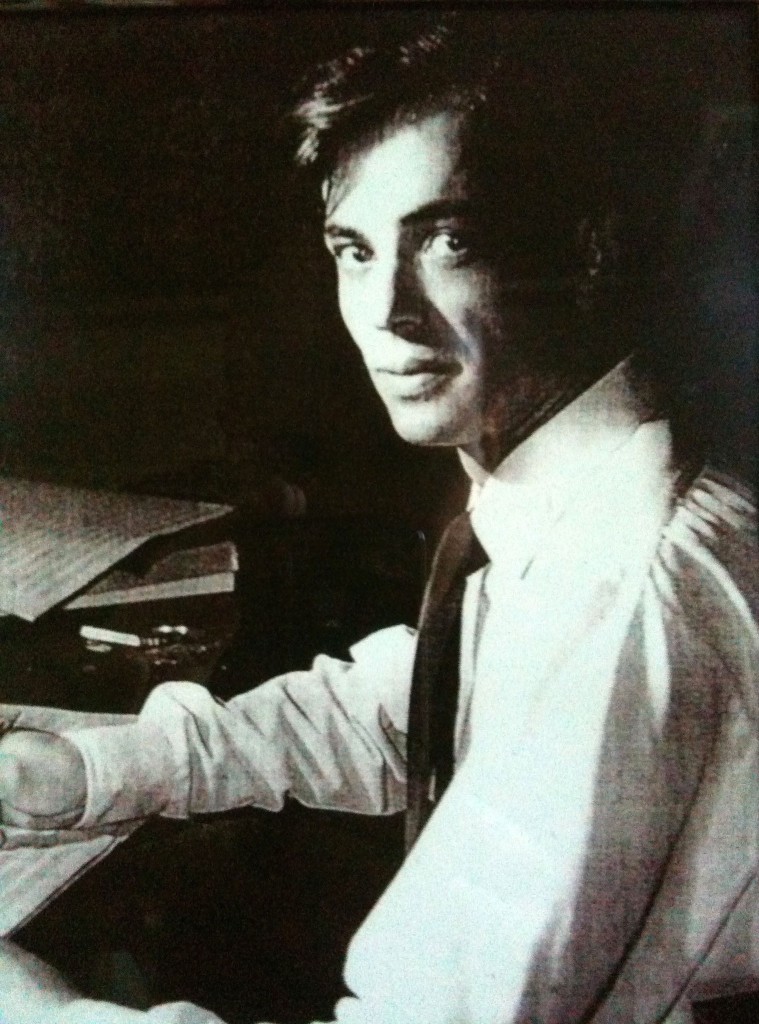
Born in the United States and raised in Scotland, Thomas Wilson rose from modest beginnings to a position of international recognition as one of the leading composers to come from Britain in the latter half of the twentieth century. From his earliest years music was central to his life.
R
eview: Thomas Wilson - Introit: Towards the Light.
Most Recent Recording
Glasgow based chamber group 'Daniel's Beard' recently made a recording of Wilson's Complementi on CD for Meridien Records (CDE 84607). Wilson's complete opus can also be heard on iTunes.
Future Performances
8 May 2012 There is no Rose | St. Gregory's Centre for Music, Canterbury, 1.00pm 20 June 2012 String Quartet No. 4 | Daniel's Beard, Cottier's Theatre, Glasgow, 6.30pm 19 January 2013 Solo Guitar Works | Stefan Grasse, Synagoge Schwabach, Schwabach, Germany, 8pm 20 January 2013 Solo Guitar Works | Stefan Grasse, Suedpunkt Nurenberg, Germany, 7.00pm
Recent Performances
July 2011 Chanson de Geste | Alec Frank-Gemmill, Sevenoaks, Kent August 2011 Guitar Works | Philip Thorne, Edinburgh 12 November 2011 Clarinet Sonatina | Daniel's Beard, Boat of Garten Community Hall, 7.30pm 18 November 2011 St Kentigern Suite | Edinburgh University String Orchestra
9 December 2011 There is no Rose | Glasgow Royal Concert Hall, 7.30pm 15 December 2011 There is no Rose | Leeds Philharmonic Chorus, Leeds Town Hall, 6.30pm & 8.30pm 25 December 2011 There is no Rose | Glasgow Cathedral Choir, 11am 18 January 2012 There is no Rose | Glasgow Cathedral Choir, 6.30pm 9 February 2012 St Kentigern Suite | BBC SSO, City Halls (Glasgow), 2pm 20 March 2012 There is no Rose | Glasgow University Chapel Choir, University Memorial Chapel, 6pm
Homage to Thomas Wilson by John Maxwell Geddes
Gemini, a full-scale orchestral work by
John Maxwell Geddes, was premiered by the National Youth Orchestra of Scotland at the Glasgow Royal Concert Hall on Saturday 4th August 2007, prior to a tour of The Netherlands and Berlin. Michael Tumelty, writing in The Herald on 25th July, describes Geddes's piece as "a homage and an elegy to his great friend Wilson". The article, which explores the unique relationship between the two composers, is reproduced in full below with the kind permission of the newspaper. "He and I were musical twins"Writing music, most composers would agree, is ultimately a solitary experience. Even with such a gregarious and communicative bunch as the new and phenomenally productive Glasgow school of composers at the RSAMD, at the end of the day it comes down to the individual facing up to a blank sheet of manuscript, armed only with inspiration, or lack of it.
Historically, there has been in Scotland one striking exception to the norm: the relationship between John Maxwell Geddes, now 65, and the late Thomas Wilson, two of the country's finest composers. Each was highly individual and quite distinctive from the other, both in character and in their music.
They didn't collaborate as such. They didn't write joint pieces or work as a collective. But they had a deep friendship that extended back to the time they met in the 1960s. They would share ideas. They used each other as sounding boards. They would pass to each other completed scores and works in progress. Everything was up for discussion and debate, from detail to philosophy. I was privileged to attend, in a fly-on-the-wall capacity, several of their evening meetings, which ran late into the night, and was struck by the openness with which each would lay out his musical creations and ideas to the other's critical gaze.
"We were musical twins, or perhaps I was the younger brother," reflected Geddes, chewing over the origins and inspiration of his new orchestral composition, Gemini, a commission from the National Youth Orchestra of Scotland that will be premiered in Glasgow next Saturday.
Gemini, a full-scale, 20-minute composition, is a homage and an elegy to his great friend Wilson, who died in 2001. The piece didn't start out that way. Geddes was commissioned by NYOS to write a 20-minute orchestral piece, but not a symphony (he already has three to his name).
Without any real certainty of what his new NYOS piece would be about, or what form it might take, Geddes found that as he worked last year on other commissions, something started to happen. "Unbidden came the sort of motivic writing associated with Tom; not from specific compositions, but his thumbprints, his hallmarks, as it were."
Parallel with this experience came the impulse to write a dualistic music that would couple a traditional "high-energy, high-activity music", which is one characteristic of Wilson's music, with its opposite: music that appears to be still and timeless, which is a strong and enduring feature in Geddes's orchestral and smaller-scale music.
As all of these strands came together, Geddes seemed to realise he was thinking more and more about Wilson. "Tom and I talked often and long into the night about the idea of stasis in symphonic music. Was it possible? Or did music always have to be an interminable march to the coda?"
The two friends did not agree (as any familiarity with Wilson's more propulsive, driving, energetic music will confirm). "Tom always argued that stasis was an illusion, and that the illusion was only possible if you had activity or kinesis all around it."
It wasn't all they disagreed about. Wilson was a man of deep religious faith. Geddes has no religious faith. Wilson wrote religious music. The idea of composing religious music is alien to Geddes. Wilson was drawn to the medium of opera. Geddes has no interest in it; symphonic, chamber, and instrumental music are his preferred genres.
But there was no real dispute between the two men, nor between their two very different types of music.
All of this has fed into the creation of Geddes's homage to Wilson. The references to Wilson are internal, beneath the bonnet of the orchestral engine, as it were. Those who know Wilson's music should not go hunting for signs. There are no direct quotes, though some of the senior composer's trademark motives, rhythms and general dynamism will colour Geddes's Gemini.
Apart from any technical considerations, Gemini is a tribute, memorial, elegy - call it what you will - from one of Scotland's best composers to another. "Tom, in my lifetime, was a central figure in 20th-century music, and a great influence on Scottish music generally."